

Most manufacturing facilities were designed for stable demand, predictable product lifecycles, and consistent labor availability.
That world no longer exists.
Manufacturers now face fluctuating volumes, shifting product mix, labor constraints, automation risk, and pressure to respond quickly to market changes. Facilities optimized for a single set of assumptions often become constraints when those assumptions change.
Successful manufacturing facility planning requires more than designing for today’s production needs. An effective facility design process considers future product changes, labor availability, automation, scalability, and operational flexibility. Manufacturers that invest in strategic facility planning are better positioned to respond to changing markets while reducing long-term operating costs.
At Campbell Corporation, we specialize in facility design for manufacturers dealing with uncertainty. We help teams build layouts that perform under real operating conditions, not just on paper.
Facility Layout Is a Business Risk Decision
Facility layout is an engineering decision with long-term business consequences. It directly affects operational risk.
The layout you put in place determines the cost of change and how easily you can add capacity, introduce new products, shift labor, integrate automation, and meet changing customer requirements without disruption.
Most companies do not fall behind because of small inefficiencies. They fall behind because their facilities are difficult and expensive to change.
Why Traditional Facility Design No Longer Works
The facility design process starts long before equipment is installed.
Effective manufacturing facility planning evaluates workflow, capacity, labor, automation, inventory movement, utilities, and future expansion before layout decisions are finalized.
Conventional facility design typically centers on a single forecast:
- Fixed production volumes
- Department-based layouts
- Dedicated equipment
- Static material flow paths
While these designs may appear efficient initially, they often fail when demand changes, new products are introduced, or labor availability shifts.
The result is increased work-in-process (WIP), longer lead times, higher operating costs, and repeated layout rework.
The Manufacturing Environment Has Shifted
Modern facility design needs to account for:
- Demand variability and uneven order patterns
- Frequent product changes and shorter lifecycles
- Labor shortages and mixed skill levels
- Static material flow paths
- Automation and capital investment uncertainty
- Reshoring, defense, and regulatory requirements
Facilities that ignore these factors inevitably limit their own capacity for responsiveness, growth, and profitability.
Facility Design Principles for Uncertain and Dynamic Conditions
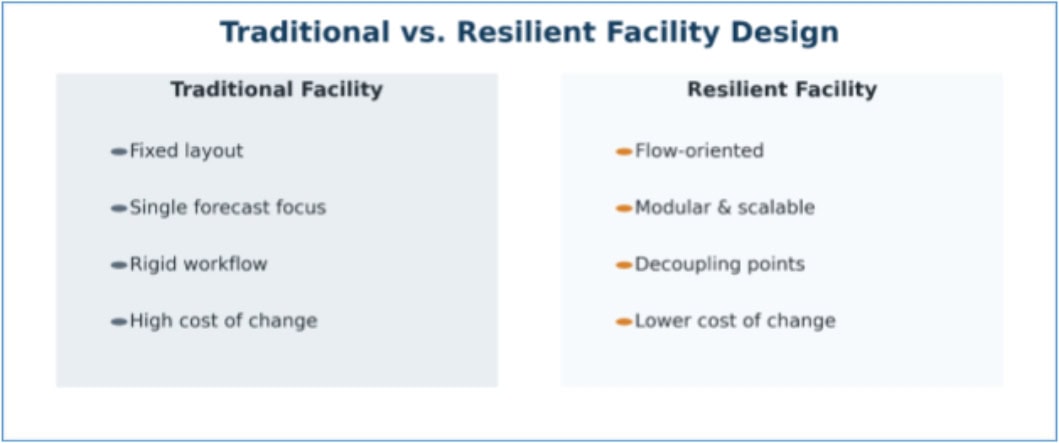
- Design for Flow, Not Departments
Layouts organized around value streams and material flow outperform departmental layouts. Flow-based designs reduce lead time, make constraints visible, and adapt more easily to changes in volume and mix.
- Use Modular and Scalable Capacity
Flexible facilities rely on modular processes instead of large fixed systems. Capacity should increase or decrease without requiring a full redesign.
- Decouple Where It Adds Value
Not every process needs to be tightly linked. Well-placed decoupling points protect flow and prevent variability from affecting the entire system.
- Avoid Over-Specialization
Highly specialized equipment and layouts lock manufacturers into current product assumptions. More flexible processes hold up better across multiple product generations.
- Design for Changeover and Reconfiguration
Frequent product changes require layouts that support fast, safe reconfiguration. This needs to be part of the design, built in from the start, not handled later.
- Plan for Expansion and Contraction
Resilient facility design accounts for both growth and contraction. Layouts need to expand or consolidate without disrupting operations or creating safety issues.
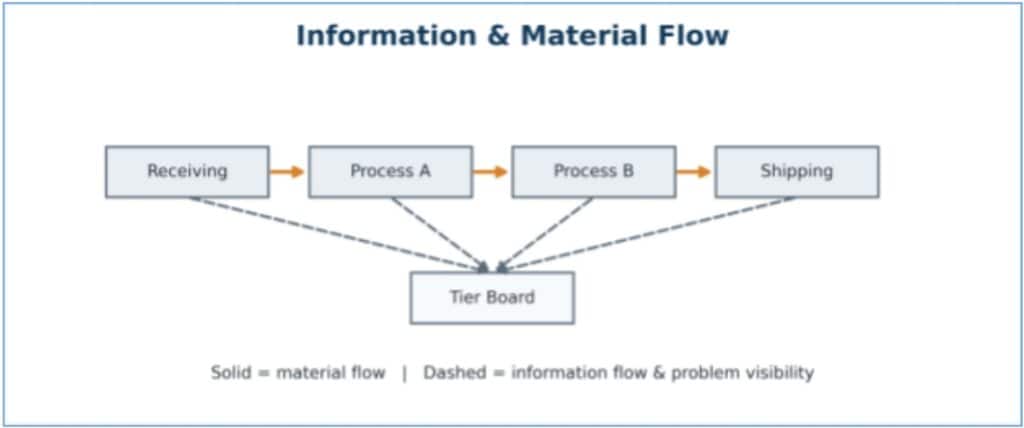
- Improve Information Flow and Problem Visibility
A strong layout supports communication, supervision, and faster problem-solving. Clear visibility helps teams identify and address issues quickly.
- Build Safety into the Layout
Safe facilities are the result of good design, not just good policies. Clear, predictable flow reduces conflict and confusion between people and equipment. When flow improves, safety improves, and throughput thrives.
- Preserve Future Options
The most expensive facility decisions are those that eliminate future options and limit flexibility. Design choices should allow phased investment, practical automation pathways, and layout changes with minimal disruption.
Manufacturing Facility Planning Checklist
A successful manufacturing facility planning project should answer questions such as:
- Can production volume double without major reconstruction?
- Are material flows optimized?
- Can automation be added later?
- Are utilities planned for future equipment?
- Does the layout minimize travel distance?
- Can departments be reconfigured?
- Are bottlenecks visible?
- Does the design support multiple product families?
Common Facility Design Mistakes
Manufacturers often create long-term constraints by:
- Designing around a single “hero” product or short-term forecast
- Locking into functional departments instead of value streams
- Automating unstable or poorly designed processes
- Optimizing local efficiency instead of overall system performance
- Treating flexibility as unnecessary cost instead of risk reduction
These decisions are difficult and expensive to reverse once capital is committed.
What Effective Facility Design Delivers
Well-designed manufacturing facilities consistently achieve:
- Shorter, more predictable lead times
- Lower WIP, even with demand variability
- Faster new product introduction
- Reduced cost and disruption when layouts need to change
- Better long-term return on capital investments
Most importantly, they allow leadership teams to respond to change without reworking the facility every time conditions shift.
Campbell Corporation’s Approach to Facility Design
We design facilities based on how they will actually operate.
Our approach integrates:
- Lean manufacturing principles focused on flow and stability
- TAKT-based capacity and flow analysis
- Scenario planning for changes in volume and product mix
- Greenfield and brownfield facility design
- Tradeoff analysis to manage capital risk
We work directly with owners, COOs, and operations leaders to make sure the facility supports the business strategy, not limits it.
Is Your Facility Designed for Change?
If your facility was built for stable demand but now operates in a constantly changing environment, it is worth reassessing before committing additional capital.
Campbell Corporation helps manufacturers design flexible, resilient facilities that stay effective as conditions change.
Contact us to review your facility’s ability to adapt.